
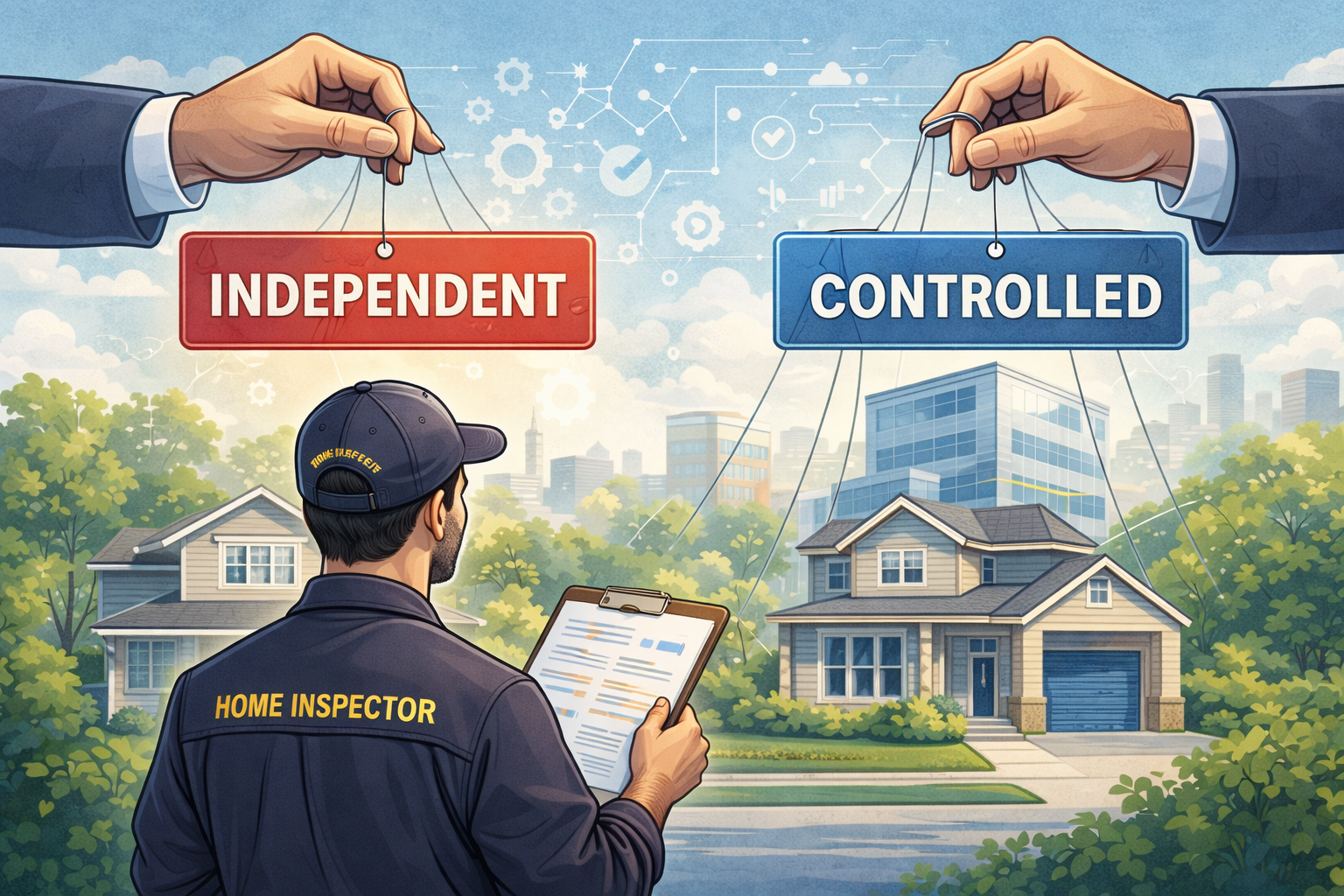
For decades, the idea of the independent home inspector carried a clear meaning. Independence meant control over work quality, professional judgment, and business decisions. Inspectors chose how they operated, managed their own risk, and were paid for the work they performed.
As inspection companies scale into multi-inspector and multi-market operations, that definition is quietly changing.
The shift isn’t dramatic or sudden. It happens incrementally, through systems, policies, and administrative layers that grow alongside the business. And while scaling has brought efficiency and consistency, it has also introduced new questions about what independence really looks like in today’s inspection industry.
Independence used to mean control
Traditional independence was straightforward. Inspectors controlled their workflow, pricing, and client relationships. Payment followed performance. Once the inspection was completed, compensation was earned.
In modern scaled operations, many of those controls move upstream.
Clients contract with companies rather than individual inspectors. Billing and refunds are centralized. Add-on services are bundled and unbundled administratively. Turnaround expectations are standardized. Compensation is calculated through configurable systems rather than direct agreements.
None of this is inherently wrong. But it does change the balance of control.
When systems replace discretion
As companies grow, systems replace conversations. Software replaces handshake agreements. Metrics replace individual judgment. These changes are often necessary to manage volume—but they can also narrow the inspector’s practical independence.
One of the most telling indicators is how payment is handled after an inspection is complete.
When compensation is contingent on post-inspection factors—administrative review, internal satisfaction standards, refunded services, or turnaround benchmarks—inspectors are no longer independent in the traditional sense. Their pay becomes conditional on decisions they don’t fully control.
This doesn’t mean inspectors are employees. But it does mean independence is no longer absolute.
The role of payment in defining independence
True independence isn’t just about scheduling flexibility or tax classification. It’s about when labor is considered complete and payable.
In many scaled models, inspectors perform the inspection, but payment is released only after a series of internal conditions are met. That structure shifts leverage toward the company and away from the inspector, even though the inspector has already delivered the core service.
Over time, this redefines the relationship. Independence becomes less about professional autonomy and more about participation in a managed system.
Scale amplifies the effect
These dynamics are more pronounced in larger organizations. The more inspectors a company manages, the more standardized its processes become. What might be an exception in a small firm can turn into a routine policy at scale.
As a result, inspectors may feel interchangeable rather than independent. Payment issues may take longer to resolve. Administrative decisions may have broader downstream effects. And individual inspectors may have less visibility into how compensation is calculated or adjusted.
Again, this is not necessarily the result of bad intent. It is often the natural outcome of growth without parallel attention to contractor autonomy.
What this means for the industry
The inspection industry is at an inflection point. Scaling is accelerating, and with it comes a redefinition of independence.
For inspectors, this means independence should be evaluated realistically, not just assumed. Control over payment timing, compensation conditions, and risk exposure matters as much as schedule flexibility or job volume.
For companies, it means recognizing that independence is not just a label. If inspectors are expected to operate as independent professionals, compensation structures should reflect that reality—paying for completed work without retroactive conditions whenever possible.
Independence is evolving, not disappearing
Independence in home inspection hasn’t vanished, but it has changed. Inspectors today operate within larger systems, more technology, and more centralized control than ever before.
Understanding how those systems affect compensation, leverage, and autonomy is essential. Independence is no longer defined solely by how inspections are performed, but by how—and when—inspectors are paid.
As the industry continues to scale, clarity around these issues will determine whether independence remains meaningful, or becomes merely a label applied to increasingly managed work.

