
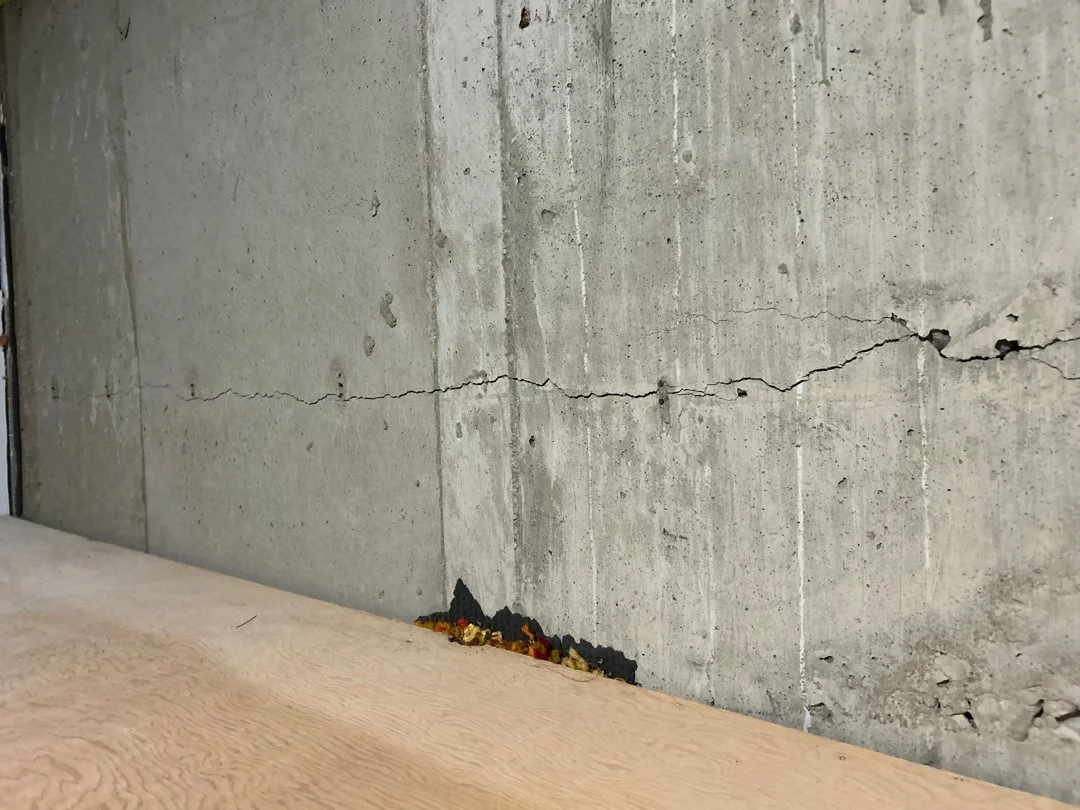
Not all foundation cracks are created equal. Some are cosmetic. Some are structural. And some are early warnings of a much larger problem developing behind the wall.
Among experienced inspectors and structural engineers, one type of crack tends to raise immediate concern:
Horizontal cracks in basement foundation walls.
Unlike small vertical shrinkage cracks that occur naturally as concrete cures, horizontal cracks often indicate that the wall is being pushed inward by external pressure.
And when that happens, the structure of the foundation itself may already be under stress.
The Pressure Behind the Wall
Basement foundation walls exist to resist the pressure of the soil surrounding them. That soil may not look like it’s doing much, but it exerts significant force against the structure.
Several factors increase this pressure:
- heavy clay soils that expand when wet
- poor drainage around the home
- clogged or missing footing drains
- saturated soil after heavy rainfall
- improperly compacted backfill
When these forces build up, the wall begins resisting pressure it may not have been designed to handle.
Over time, the concrete or masonry begins to respond.
Why Horizontal Cracks Are Different
Most vertical cracks in foundations occur from normal shrinkage or minor settlement. They often appear near corners or window openings and may remain stable for decades.
Horizontal cracks are different because they typically indicate lateral movement, not just shrinkage.
When soil pressure pushes against the wall, the middle portion of the wall can begin to bow inward. The tension created across the wall eventually forms a crack running horizontally across the structure.
Once the crack appears, the wall has already begun to deform.
Early Warning Signs Inspectors Look For
Horizontal cracking is not always obvious at first glance. In many homes, the signs appear gradually.
Inspectors often look for:
- horizontal cracks in block or poured concrete walls
- inward bowing of basement walls
- stair-step cracks following mortar joints in masonry walls
- drywall cracks above basement walls on the main floor
- doors or windows that begin sticking near foundation walls
Even small horizontal cracks deserve attention because they may indicate that pressure is actively affecting the structure.
Why Some Homes Are More Vulnerable
Certain construction conditions make basement walls more susceptible to horizontal cracking.
Older homes built with hollow concrete block foundations are especially vulnerable. These walls rely on the strength of mortar joints and may lack reinforcement found in modern construction.
Homes built in areas with expansive clay soils also face increased risk because the soil can swell dramatically when saturated with water.
Improper drainage around the home further compounds the problem.
When downspouts discharge near the foundation or grading slopes toward the house, water accumulates in the soil directly against the basement wall.
The result is increased lateral pressure exactly where the wall is weakest.
The Long-Term Risk
Once horizontal cracking begins, the condition rarely improves on its own.
As pressure continues, the wall may:
- bow further inward
- develop additional cracks
- lose structural capacity
In severe cases, sections of the wall can shift significantly, requiring extensive structural reinforcement or wall replacement.
This is why inspectors often recommend evaluation by a structural professional when horizontal cracking is observed.
Why This Matters to Buyers
Many homeowners dismiss foundation cracks as cosmetic issues.
And to be fair, many cracks are minor.
But horizontal cracks deserve careful evaluation because they often represent structural movement rather than simple shrinkage.
Identifying the issue early allows corrective measures—such as improving drainage, installing wall anchors, or reinforcing the structure—before the problem becomes far more expensive.
For inspectors, the key is understanding that a crack is not just a crack.
Sometimes it’s a warning sign from the structure itself.

